PTL & FTL Solution

Track end to end consignment for Part Truck Load (PTL) and Full Truck Load deliveries(FTL).
Schedule a demo
FTL & PTL
FTL & PTL

Enhancing Delivery Visibility with Fleetx

Enhance your fleet's efficiency with real-time inventory management, geofence updates, and streamlined digital processes for material pickup and delivery. Fleetx empowers you to optimize functionality through a rich set of features and a user-friendly cloud interface, creating an efficient and comprehensive delivery management system.

Seamless integration across services creates an exceptional user experience for full and partial truck load management

Track FTL Consignments with trips

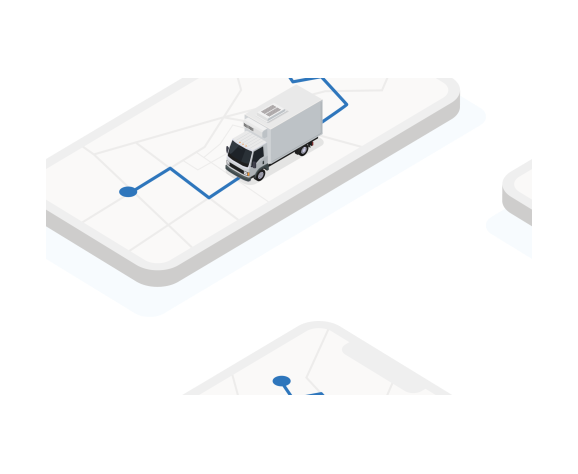
Track consignments effortlessly through Fleetx's trip management, receiving real-time updates. Share these updates effortlessly with your customers, and digitize your POD process for a paperless transparent process.
Track FTL Consignments with trips

PTL end to end trip tracking

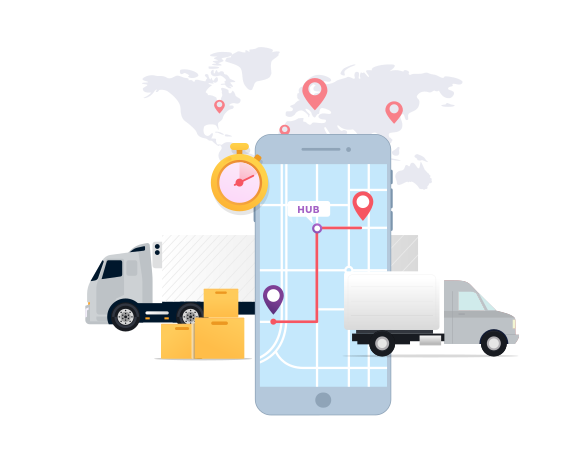
Users can manage pickups and deliveries, create automatic challans and map them to pre-scheduled trips and analyze individual vehicle’s level performance
PTL end to end trip tracking

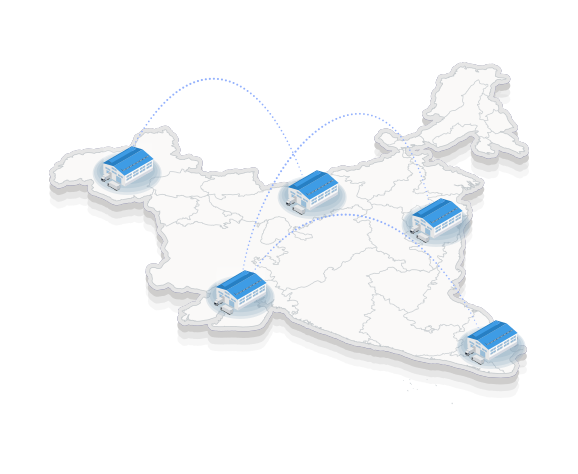
Stock Movement Visibility

Manage stock across multiple locations and get instant updates about material transfer for tracking inventory on a day-to-day basis with an access to historical data for effective auditing 
Stock Movement Visibility

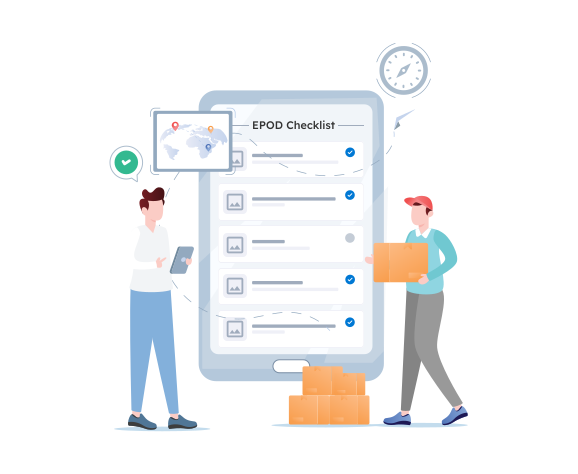
Delivery Acknowledgement

User can create delivery acknowledgement through digital POD or arrival, upload images and documents and record damages and thefts against each delivery
Delivery Acknowledgement

Frequently asked questions

What is the difference between FTL and PTL freight in India?icon
FTL (Full Truck Load) means the shipper books and pays for the entire truck capacity for a single consignment or shipment moving from one origin to one destination. PTL (Part Truck Load, also called LTL — Less than Truck Load in some markets) means multiple shippers' cargo is consolidated into a single truck, with each shipper paying only for the space their cargo occupies. FTL offers direct, faster transit and no handling at consolidation hubs; PTL offers lower cost for smaller shipments but typically involves slower transit, intermediate consolidation points, and multiple handling events. The choice depends primarily on shipment size, urgency, cargo type, and the trade-off between speed and cost.
When should a shipper choose FTL over PTL for a shipment?icon
FTL is preferable when: shipment size fills or nearly fills a truck (typically 10 tonnes or above for a 20-tonne vehicle), making PTL pricing uncompetitive; cargo requires direct transit without intermediate handling due to fragility, time-sensitivity, or temperature control requirements; the delivery deadline requires shorter transit time than PTL networks can guarantee; cargo is high-value requiring exclusive custody without co-loading risk; or the shipper requires specific vehicle types not available in PTL networks. PTL is preferable for smaller shipments — typically under 5 tonnes — where the lower per-kilogram rate more than compensates for slower transit and additional handling, and where the shipper lacks the volume to negotiate favourable FTL rates.
How do freight rates differ between FTL and PTL in India?icon
FTL rates are typically quoted per trip or per kilometre for a specific vehicle type, regardless of the actual cargo weight up to that vehicle's legal capacity. Rates vary significantly by lane, vehicle type, seasonality, and market conditions — a 24-tonne multi-axle truck on a high-demand lane like Mumbai to Delhi might cost Rs 40,000 to Rs 60,000 per trip. PTL rates are quoted per kilogram or per tonne, with slab pricing — lower per-kg rates for heavier shipments up to truck-load breakpoints. PTL rates also include handling and consolidation costs built into the per-kg rate. For shipments above roughly 60 to 70 percent of truck capacity, FTL typically becomes cheaper on a per-tonne basis than PTL, which is the standard decision threshold.
How does Fleetx help transporters and logistics companies manage FTL and PTL operations?icon
For FTL operations, Fleetx provides real-time truck tracking, consignment management, e-way bill generation, ePOD delivery confirmation, and trip profitability calculation. For PTL network operations, Fleetx adds load consolidation planning across multiple consignments per vehicle, delivery sequence optimisation across multi-stop routes, individual consignment tracking within a consolidated load, per-consignment ePOD capture, and customer-specific delivery notifications. The system manages the documentation complexity of multi-consignment trips — separate e-way bills, separate bilties, and separate delivery confirmations — with automated status updates to each consigning shipper as their specific shipment milestone is reached.
What are the key operational challenges in running a PTL network in India?icon
Running a PTL network involves significantly more operational complexity than FTL. Consolidation planning requires matching diverse cargo types, sizes, and destinations into efficient loads without prohibited co-loading combinations. Hub operations require managing high cargo volumes with accurate sorting, labelling, and onward routing — errors result in misdeliveries and expensive retrieval operations. Transit time commitments are harder to meet because delays at one stop affect all subsequent deliveries on the route. Documentation management for multi-consignment vehicles involves multiple e-way bills, multiple bilties, and multiple delivery confirmations per trip. Customer service complexity is higher because each shipper requires individual shipment status updates and proof of delivery, not just vehicle-level tracking.
How is the Indian PTL freight market structured and who are the key players?icon
The Indian PTL market is served by several distinct types of operators. Pan-India express network operators — companies like Delhivery, Gati, TCI, VRL, and Safexpress — operate hub-and-spoke networks with consolidated linehaul between regional hubs and last-mile distribution. These operators invest in technology, standardise processes, and offer guaranteed transit time commitments. Regional PTL operators cover specific geographies or corridors with competitive rates but limited national reach. And the unorganised segment — local transporters offering informal consolidation — remains significant in tier-2 and tier-3 markets. The organised PTL segment has been growing, driven by GST elimination of state border documentation requirements and e-commerce growth demanding reliable small-shipment delivery.