Monitor your cold chain logistics

Keep your perishable goods safe and fresh throughout the supply chain with our advanced cold chain logistics software solution. From temperature monitoring to route optimization, ensure quality every step of the way
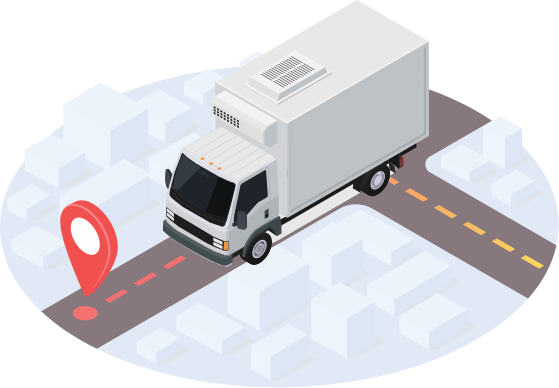
Empower Your EV

Trusted by teams at

Video Telematics

Strengthen FSSAI Compliance

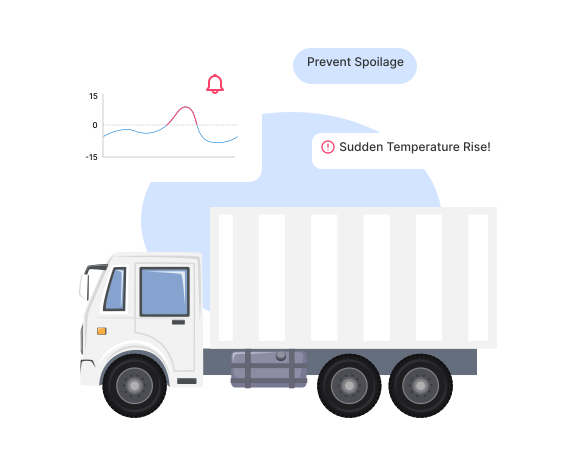
Real-time temperature alerts, delay alerts & interactive reports provide customers with minute-by-minute breakdowns of all temperature and sensor data points to prove product transport conditions. Fleetx reefer & cold storage solutions monitors temperatures in-transit to prevent product spoilage and rejected deliveries
Strengthen FSSAI Compliance

Reduce Rejected Load Claims

With detailed historical temperature records of all vehicles. Provide customers with a single report showing minute-by-minute breakdowns of all temperature and sensor data points to prove product transport conditions

Reduce Rejected Load Claims

Instant SMS, E-mail & App Notifications

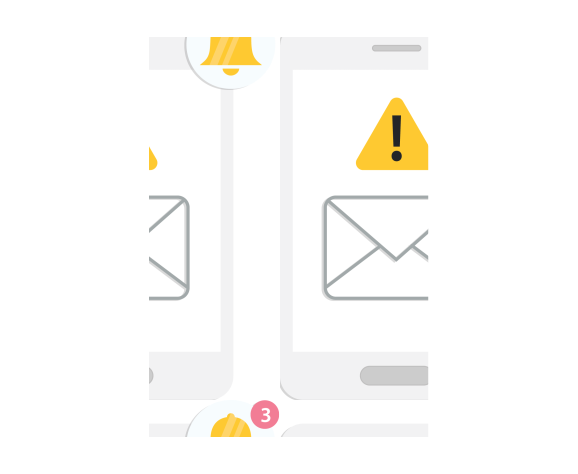
Just set the temperature range limits and get real-time alerts & notifications when temperature goes beyond threshold values to avoid shipment spoilage, reduce operational costs
Instant SMS, E-mail & App Notifications

Foreseeing the temperature problem

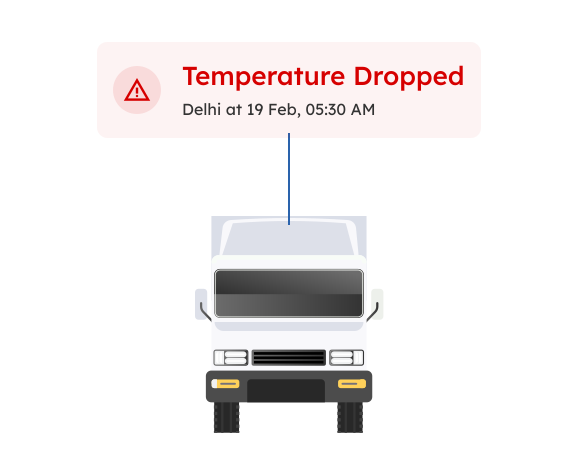
Temperature sensors help in monitoring the refrigerator temperature throughout the journey and predictive analytics help in foreseeing the temperature sensor problem, thereby, reducing the shipment damage and increasing the ROI.
Foreseeing the temperature problem

Reefer Vehicle

Maintain a desired in-vehicle temperature, aided by the real-time reefer temperature tracking. Preserve the quality and safety of perishable goods effectively throughout the transportation process.
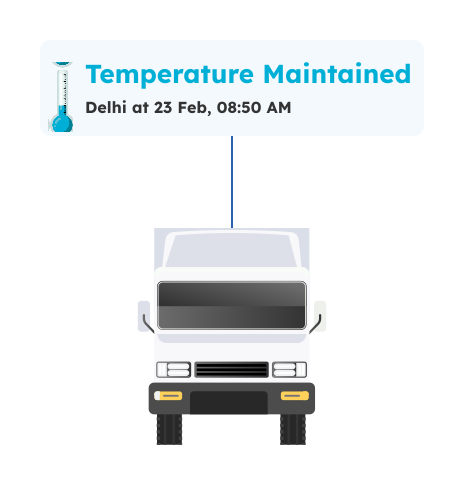
Reefer Vehicle

Frequently asked questions

What is cold chain logistics and what industries depend on it in India?icon
Cold chain logistics is the temperature-controlled supply chain for products requiring refrigeration or freezing throughout storage and transport to maintain quality, safety, and regulatory compliance. In India, industries dependent on cold chain logistics include: food and beverages (dairy, meat, seafood, fresh fruits and vegetables, processed foods, confectionery); pharmaceuticals (vaccines, biologics, temperature-sensitive APIs and finished products with typically 2°C to 8°C or 15°C to 25°C requirements); chemicals (certain industrial and agricultural chemicals requiring temperature stability); and floriculture (cut flowers for domestic and export markets). India's cold chain infrastructure has grown significantly but remains under-developed relative to the country's food production scale, resulting in significant post-harvest losses.
What are the main challenges in cold chain logistics in India?icon
Indian cold chain logistics faces several interconnected challenges. Infrastructure gaps — cold storage capacity, particularly pre-cooling facilities at farm level, is insufficient relative to perishable production volumes. Power reliability — cold chain integrity depends on uninterrupted power; frequent outages in many regions require diesel backup, adding cost and creating failure risk. Last-mile challenges — refrigerated vehicle availability at the sub-district level for farm-to-warehouse and warehouse-to-retail movements is limited, and smaller operators often use non-refrigerated vehicles for short distances, breaking the cold chain. Regulatory compliance complexity — food safety regulations under FSSAI and pharma cold chain guidelines under Schedule M require documentation, monitoring, and audit trails that many small operators cannot manage systematically. And high cost — cold chain logistics costs two to three times more than ambient logistics, limiting adoption for lower-value perishables.
How does temperature monitoring technology work in cold chain vehicles?icon
Temperature monitoring in cold chain vehicles uses electronic sensors placed inside the refrigerated cargo compartment (typically at multiple positions — near the evaporator, at mid-load, and near the door — to detect temperature gradients). Sensors continuously measure and log temperature at configurable intervals (typically every 5 to 15 minutes). Data is transmitted to the fleet management platform over cellular connectivity, enabling real-time temperature visibility alongside vehicle GPS location. Alerts are generated immediately when temperature readings fall outside the specified range — both below minimum (freezer failure in a dairy chain causing partial thaw-and-refreeze) and above maximum (refrigeration unit failure or door left open). Data is logged with timestamps for regulatory compliance records.
What are FSSAI and Schedule M cold chain compliance requirements in India?icon
FSSAI (Food Safety and Standards Authority of India) regulations for food cold chain operations require: maintenance of specified temperatures for different food categories throughout storage and transport; temperature monitoring records at all stages; personnel training in food hygiene; vehicle hygiene and sanitisation protocols; and traceability records linking each batch of food to its cold chain journey documentation. For pharmaceutical cold chain, Schedule M of the Drugs and Cosmetics Act requires validated cold chain equipment with calibrated temperature monitoring, documented temperature excursion management procedures, risk assessment for any excursions, and data retention for specified periods for audit. Both frameworks require automated, tamper-evident temperature logging rather than manual records — making digital monitoring a compliance requirement rather than optional.
How does Fleetx support cold chain fleet management and temperature compliance?icon
Fleetx integrates temperature sensor data from refrigerated vehicles alongside standard GPS tracking, driver behaviour monitoring, and consignment management in a single platform. Temperature readings are displayed on the same dashboard as vehicle location, enabling operations teams to see at a glance which vehicles are maintaining specified temperature ranges. Automated temperature alerts fire immediately when readings go out of range. Temperature logs are stored with GPS location and timestamp for every reading, creating the tamper-evident compliance documentation required by FSSAI and Schedule M. Trip-level temperature reports can be generated and shared with customers or regulatory inspectors. For multi-compartment vehicles serving multiple temperature requirements in a single trip, Fleetx tracks each compartment independently.
What types of vehicles are used in cold chain logistics in India and what are their typical applications?icon
Indian cold chain operations use several vehicle categories. Small insulated vans and three-wheelers without active refrigeration are used for short-duration last-mile deliveries where passive insulation maintains temperature adequately. Medium refrigerated vans (1 to 3 tonne payload) serve urban distribution for dairy, bakery, and pharmaceutical deliveries requiring door-to-door service in congested areas. Large refrigerated trucks (5 to 10 tonne) handle intercity primary distribution from cold storage hubs to regional distribution centres. Multi-axle refrigerated trailers transport bulk temperature-sensitive cargo on long-haul lanes — for example, bulk dairy from processing plants to distant markets. Reefer containers transported by truck provide flexibility for high-value pharmaceutical and export-quality food cargo where precise temperature control, data logging, and container integrity are paramount.
